An AI associate
for the whole matter
Clerk researches the full Luxembourg jurisprudence, reads your case file, computes the deadlines and indemnités, and drafts on your letterhead — an agent with its own workspace, not just a chatbot.
Mon client, cadre depuis 8 ans, a été licencié avec effet immédiat pour faute grave. Le licenciement est-il abusif ? Calcule les indemnités et trouve la jurisprudence.

Réflexion
J’examine un licenciement avec effet immédiat pour faute grave après huit ans d’ancienneté. Je vérifie la procédure, j’apprécie la gravité de la faute, puis je chiffre les indemnités dues.
Consultation de documents
contrat_de_travail.pdfPDFCalcul des indemnités
Préavis L.124-1 : 4 moisIndemnité de départ L.124-7 : 2 moisBase : 5 800 € brutRecherche dans la jurisprudence
faute grave absences injustifiéesproportionnalité de la sanctioncharge de la preuve employeurLecture d’une décision
C.S.J., n° 145/23 — 14 mars 2023Réflexion
La Cour exige une faute rendant immédiatement impossible la poursuite du contrat. De simples absences, sans avertissement préalable, sont rarement qualifiées de faute grave — le licenciement paraît abusif.
Built on the full Luxembourg jurisprudence — every decision, cited to its source

Jurisprudence research
Search 45,957 Luxembourg decisions — Clerk returns the handful that apply, each read in full and cited to its source.
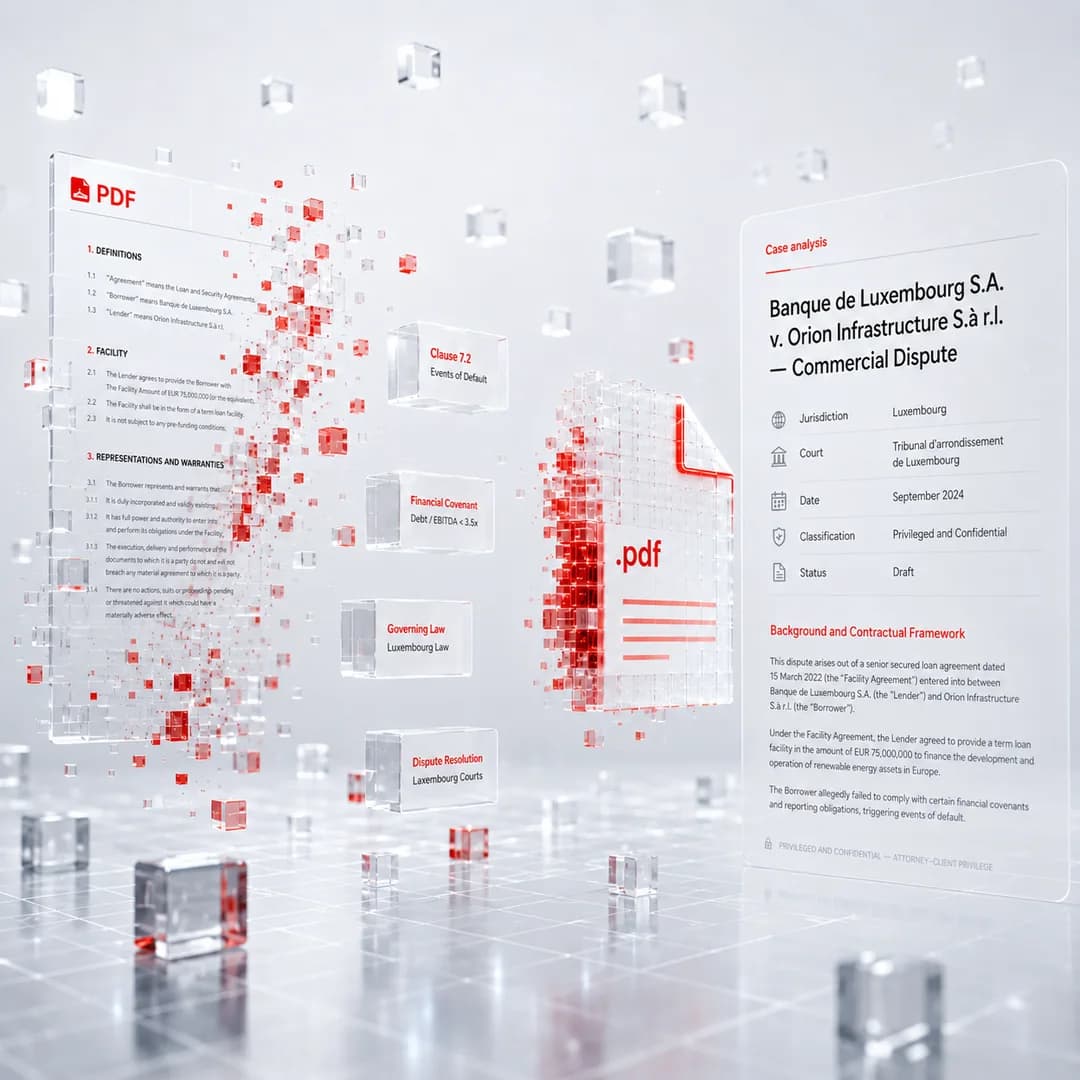
Document analysis
Drop in scanned judgments or contracts in French or German — Clerk OCRs every page and extracts the facts, clauses and dates that matter.
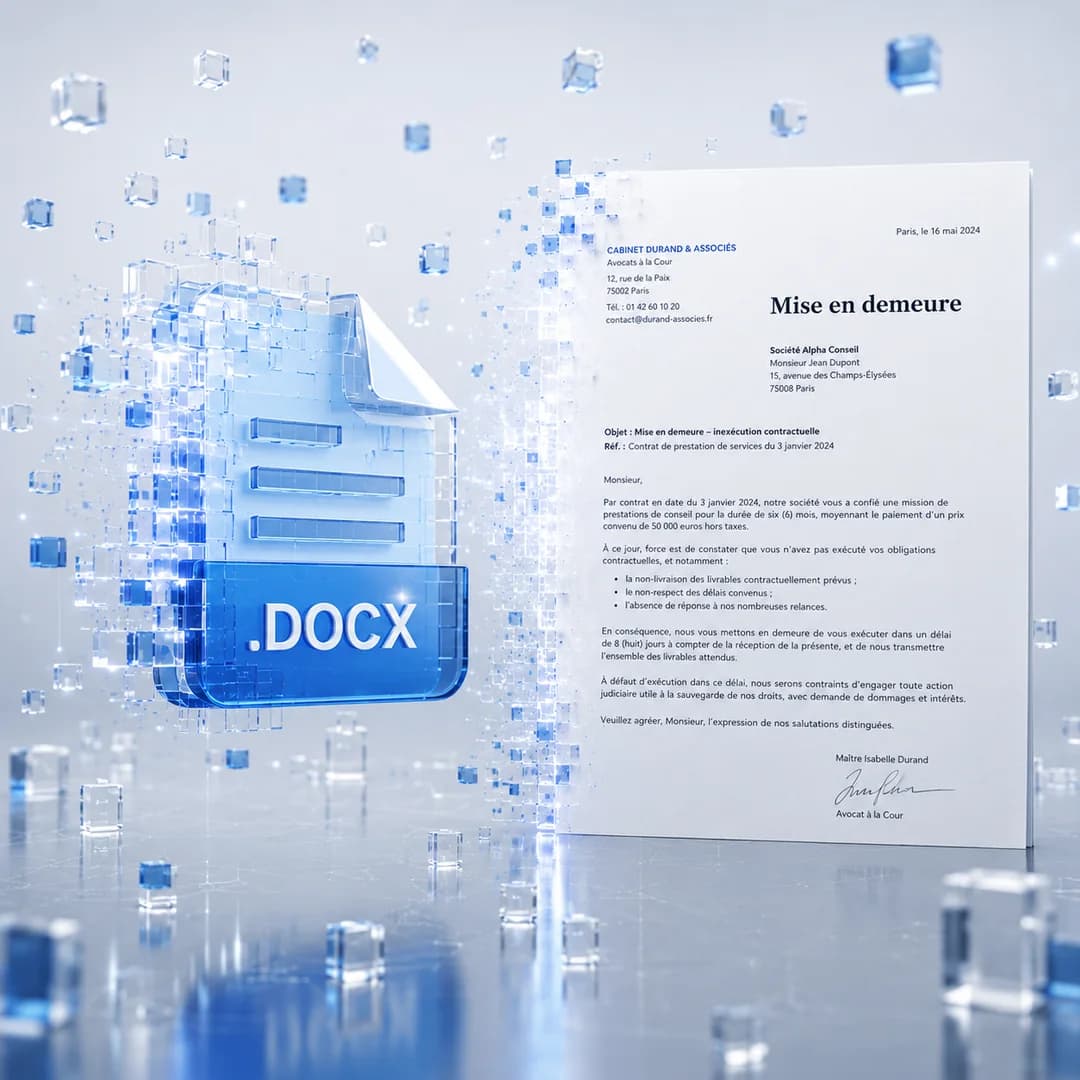
Drafting & pleading
Mises en demeure, conclusions and plaidoiries — drafted from the file and exported as a polished .docx or PDF on your firm's letterhead.
From the first consultation
to the hearing
Task Clerk with any part of a matter — research, deadlines, drafting — and it works beside you like a colleague, showing its reasoning at every step.
Analyse le dossier : le licenciement est-il abusif, à quelles indemnités mon client a-t-il droit, et prépare une mise en demeure.
Consultation de documents
assignation.pdfPDFfiches_de_paie.pdfPDFRéflexion
Je reconstruis la chronologie, je vérifie l’ancienneté et le motif invoqué, puis je chiffre les indemnités et recherche la jurisprudence sur la faute grave.
Calcul des indemnités
Préavis L.124-1 : 4 moisIndemnité de départ L.124-7 : 2 moisRecherche dans la jurisprudence
faute grave non caractériséeproportionnalitéRédaction d’un document
mise_en_demeure.mdMD
Take on more matters,
not more overhead
Argue like a bigger firm
Clerk searches the entire Luxembourg jurisprudence and reads each candidate decision in full — so a two-person practice argues with the depth of a much larger firm.
Never let a délai slip
Procedural deadlines, prescription periods and indemnités are computed the moment the facts land — with the governing article attached and the échéance on the matter's calendar.
Grounded, every time
Every moyen comes with its counter-argument and a confidence marker, and any claim Clerk couldn't ground in a source it actually read is flagged — the weak link surfaces on your desk, not at the hearing.
Works every part
of the matter
Research, document analysis, deadlines, drafting and argument — each grounded in the Luxembourg corpus, and each one a tool the agent reaches for on its own.
Search the whole corpus, read what matters
Clerk searches all 45,957 Luxembourg decisions, opens the ones that apply, and cites each to its source — the trawl through justice.public.lu disappears.
À quelles conditions une clause de non-concurrence est-elle valable, et la jurisprudence l’a-t-elle déjà annulée faute de limite géographique ?
Réflexion
La validité s’apprécie au regard de l’article L.125-8. Je recherche les décisions sur les conditions de validité et la sanction d’une clause trop large.
Recherche dans la jurisprudence
clause de non-concurrence validitélimitation dans le temps et l’espacerémunération minimale L.125-8Lecture d’une décision
C.S.J., n° 78/22 — 19 mai 2022Réflexion
La clause doit être écrite, limitée à deux ans, circonscrite à un secteur — à défaut de limite géographique raisonnable, elle est nulle.
Work every matter
together
Clerk isn't a private chatbot — it's a shared workspace. Bring colleagues into a matter, watch the agent and your team work it in real time, and pass documents back and forth in one secure place.
Shared conversations
Open a matter to the colleagues who need it — as lead, contributor or observer — and keep everyone on the same thread.
Real-time, together
A colleague's message and the agent's reply land instantly for everyone on the matter — no refreshing, no forwarding screenshots.
Share documents
Hand a generated draft or an exhibit to a teammate; they accept it into their vault, and you can revoke access at any time.
Full organisation management
Bring your whole étude into one workspace: onboard the team, give everyone the right role, and keep usage and access under control — all from a single Cabinet view, with everything logged.
Onboard your team in minutes
Invite colleagues by email; each accepts into their own seat — no shared logins, no IT ticket.
Roles & permissions
Owner, admin and member at the firm; lead, contributor or observer on each matter — everyone sees exactly what they should.
Usage limits per member
Set a monthly cap per seat or pool it across the firm — usage is metered to the token, with caps enforced before a turn runs.
Audit & oversight
Every invite, role change and access is logged, and confidential matters stay hidden — even from admins.
Every team.
Every practice.
From a sole practitioner to the largest étude, Clerk works the matter the way your practice does — grounded in Luxembourg law, whatever the sector.
More matters, not more hours.
Hand Clerk the high-volume work — research, first drafts, deadline math — so your associates spend their hours on judgment and clients instead of the trawl through justice.public.lu.
Questions and answers
Matters and documents stay within EU data residency, and your content is never used to train third-party models. Personal data is anonymised before any AI processing, and you review every replacement first.
Put Clerk on the matter
Open a matter, hand Clerk the file, and keep your own focus on strategy and your clients — it works the rest and shows you everything it did.
Ouvre le dossier, analyse les pièces et dis-moi par où commencer.
Exploration du dossier
dossier/Réflexion
Je passe en revue les pièces, j’identifie la nature du litige et les délais qui courent, puis je propose un plan d’action.
Consultation de documents
assignation.pdfPDFCalcul des délais
Constitution avocat : 15 joursÉchéance : 20 juin 2026